I'm posting a copy of the presentation we saw in class last week. Please take another look at it and keep it in mind during the year and in the future!!
Mostrando entradas con la etiqueta WRITING. Mostrar todas las entradas
Mostrando entradas con la etiqueta WRITING. Mostrar todas las entradas
lunes, 13 de noviembre de 2017
THE WRITING PROCESS
Hello,
I'm posting a copy of the presentation we saw in class last week. Please take another look at it and keep it in mind during the year and in the future!!
I'm posting a copy of the presentation we saw in class last week. Please take another look at it and keep it in mind during the year and in the future!!

INFORMAL E-MAILS
INFORMAL E-MAILS

Informal e-mails and letters are sent to people you
know well (e.g. friends, relatives, etc.) about your recent news, personal
problems, information you need, etc.
They are written in an informal style using:
-
Contractions
-
Colloquial expressions and informal structures/vocabulary
-
Shortenings and abbreviations
-
Phrasal verbs
-
Exclamations and questions
Useful sentences
and expressions:
1.
GREETING:
Hi/Hello (+ name),
Hello there,
2.
INTRODUCTION:
-Questions/ Wishes about the person’s health:
How are you? I’m fine.
I hope you’re well / I hope you’re feeling better
-A thank you to the person for their last e-mail/ letter:
It was
great/nice/lovely to hear from you again.
Thank you so much for your (lovely) letter/e-mail of … November 30th
-Comments about their news:
I was really sorry to hear that
you… are ill.
It was really great to … get all your news.
It was a nice surprise to … hear from you after all this time.
I’m glad that … you’re enjoying your new job.
-An apology for a delay in writing:
Sorry for/about not writing earlier but … I’ve been very busy preparing
for my exams.
-The reason why you are writing:
I’ve got
some good news! I’ve got a new house.
The reason why I’m writing is to
… ask you if you would like to come to Tenerife next Christmas.
I’m writing (to you) to see how
you’re getting on … in your new flat/ with your new boy/girlfriend.
3.
BODY: main subject(s) of the e-mail/letter in detail,
starting a new paragraph for each
topic.
-Congratulating:
Congratulations!/ Well done!
Congratulations on sth / congratulate sb
on sth / congratulate sb for doing sth: I’ve just heard that you passed all
your exams. Congratulations! Congratulations on your new job
-Apologizing:
I’m (really) sorry for (sth/sb/ + verb-ing):
Sorry for arriving late at your party.
I’m sorry about (sth/sb/ + verb-ing): I was
sorry about your father.
I’m sorry + (that) …: I’m sorry (that) I
got so angry.
I’m sorry + to infinitive: I was sorry
to miss your concert.
-Inviting:
I’m writing to invite you to … my
birthday party on 26th July.
Would you come and spend next Easter with us
at our apartment in the south of Tenerife?
After the invitation you can add the following
sentences:
Think about it … and tell me soon.
Let me know… if you can come.
I hope you can. / I really hope you can
come.
-Thanking:
Thank you for + sth/-ing : Thank you for
your invitation to stay with you for a week in August.
After thanking, to describe how you felt you can say: I had a fantastic/great/wonderful time.
I enjoyed it a lot more than I expected. I would love to do it again.
-Making suggestions/ Giving advice:
I think we/you should …, We/You should …, We/You shouldn’t …, We/You could …, We/You can…
I think you
should do some exercises and eat lots of fruit and green vegetables. You
shouldn’t drink tea or coffee, but you could try chamomile tea, because it
helps you relax. You can get a train to Brighton from the airport.
Why don’t you/we …?:
Why don’t you come in July? It would be great
if we/you could…: It would be great if we could meet.
I think the best thing would be to … leave your job. It would
be a good idea to… go on holiday together.
Imperative: Go to a specialist so s/he can tell you
what to eat.
Second conditional: If I were you, I
would (+ inf)…: If I were you, I would travel by bus. After the advice you can
say: I hope that this advice helps.
-Asking for advice/opinion:
I’ve got a problem and I’d like your
advice.
I’m writing to ask for your advice.
I’m writing to ask you if you could advise me
on/about/of … how to lose weight.
What do you think is … the right thing
to do?/ the best month for me to go?
4. CONCLUSION:
- The reason why you must end the e-mail/letter:
I have to finish now.
(Well) that’s all for now.
(Well) that’s all my news.
Greetings to
the person’s family / friends:
Give my regards/ love to your family/ to Sarah.
My mother sends her love.
A request to the person to reply soon:
(I’m) Looking forward to hearing
from you.
(I’m) Hoping to hear from you
soon.
(I) Hope to hear from you soon.
(I’m) Looking forward to seeing you soon
(Please) Write soon and tell me
all your news.
A promise to write again soon:
I’ll write as soon as I can.
I promise I’ll come back and visit all of you as soon as I can.
Hope to see you soon/ at Christmas.
I hope that my advice helps.
Thanks again for … everything / … remembering my birthday / … the
invitation.
Don’t forget my invitation to Tenerife.
5. CLOSING FORMULAS:
For close friends and relatives:
All my love/ Lots of love/ Love/Lots of kisses,
Your name
More neutral:
Best wishes/ Regards/ Kind regards/Bye for now/Take care/See you soon,
Your name
6. POSTSCRIPT:
PS I attach … a photo of
the three of usmiércoles, 1 de febrero de 2017
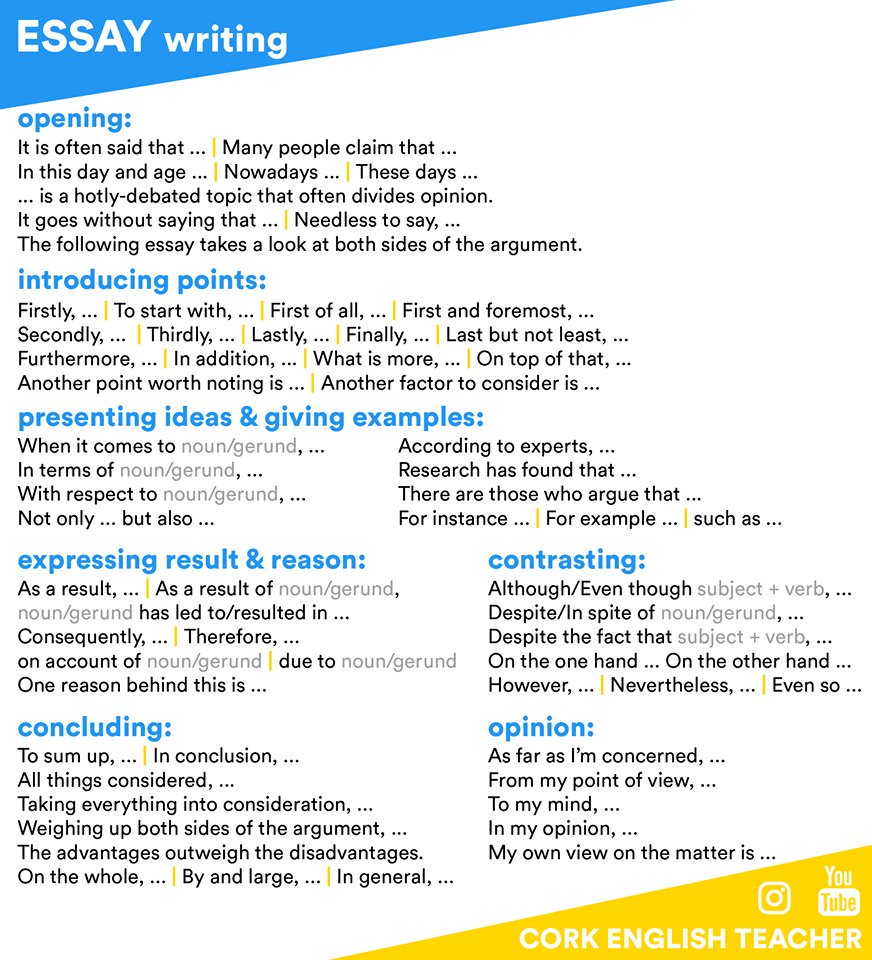
viernes, 23 de diciembre de 2016
SHOW AND TELL
USEFUL EXPRESSIONS FOR AN ORAL PRESENTATION
|
Effective
Openings
In order to grab the attention of the
audience you may employ one of the following devices:
1. Rhetorical questions
2. Interesting facts
According
to an article I read recently, … Did you know that … ?
I’d like to share an amazing fact / figure with you.
3. Stories and scenarios
Let
me tell you what happened to me … Suppose ... Imagine ...
4. Problems to think about
Suppose you wanted to … .
How would you go about it?
Imagine you had to … .
What
would be your first step?
5. Quotations.
As … once said, …
To quote a
well-known writer, …
To put it in the words of …
|
Introducing a Point
First of all I'd like to point out
...
The main problem is ...
The question of ...
Speaking of ...
Going
back
As I said /
mentioned earlier, …
Let me come back to
what I said before
Let’s go back to
what we were discussing earlier.
As I’ve already
explained, …
As I pointed out in
the first section, …
Moving
to the next point
This leads directly
to my next point.
This brings us to
the next question.
Let’s now move on /
turn to …
After examining this
point, let’s turn to … Let’s now take a look at …
|
|
Rephrasing Expressions
What I meant to say was…
Let me rephrase that…
Let me put this another way…
Perhaps I'm not making myself clear…
The basic idea is…
One way of looking at it is…
Another way of looking at it is…
What I want to say is…
|
Stating
something as a fact
As everyone knows ...
It is
generally accepted that ...
There can be no doubt that ...
It is a fact
that ...
Nobody will
deny that ...
Everyone
knows that ...
|
|
Indicating
the end of your talk
I’m now approaching / nearing the end of my
presentation.
Well, this brings me to the end of my presentation.
That covers just about everything I wanted to say
about …
As a final point, I’d like to …
Finally, I’d like to highlight one key issue.
|
Drawing
conclusions and summing up
The obvious conclusion is ...
Last but not least ...
The only alternative (left) is ...
The only possible solution/conclusion is ...
In conclusion we can say that ...
To cut a long story short
Just to give you the main points again, ...
|
lunes, 7 de noviembre de 2016
CV AND COVERING LETTER USEFUL SENTENCES
AVANZADO 1
CV AND COVERING LETTER USEFUL SENTENCES
Hello,
When writing a CV you need to use formal language, most of the times there are set expressions or formulas to convey a particular meaning. In the link below you'll find a complete account of some of the most common phrases to use when you try to describe your work experience, duties, qualifications or interests. There are maybe too many (sorry!) but they are divided in sections, so you can focus on the meaning you are dealing with and choose the one that better suits you.
Hope it helps!
https://dit.ie/media/careers/pdf/CV%20and%20Cover%20letter%20-%20useful%20pharases.pdf
CV AND COVERING LETTER USEFUL SENTENCES
Hello,
When writing a CV you need to use formal language, most of the times there are set expressions or formulas to convey a particular meaning. In the link below you'll find a complete account of some of the most common phrases to use when you try to describe your work experience, duties, qualifications or interests. There are maybe too many (sorry!) but they are divided in sections, so you can focus on the meaning you are dealing with and choose the one that better suits you.
Hope it helps!
https://dit.ie/media/careers/pdf/CV%20and%20Cover%20letter%20-%20useful%20pharases.pdf
Suscribirse a:
Comentarios (Atom)